Ghost-touch
The Reincarnated Demon King's Host Just Wants to Live in Peace, But the Hero Won't Leave Him AloneGhost-touch is the bodily consequence of supernatural contact with ghosts. It is not presented as an instantaneous wound that ends when the apparition withdraws; a minor brush can continue to worsen, while a direct passage through the body can bring a victim close to death. The condition therefore links the invisible world of the dead to visible physical deterioration, making haunting a communal medical emergency rather than merely a source of fear.
Symptoms and Progression
The most immediate sign of ghost-touch is a corpse-like change in the body. In the inn at Ashenhave, victims lie on bedrolls with exposed skin that has turned grey and blue, while their lips, eyelids, and nostrils look almost frostbitten. Theo senses the affliction in the air as something resembling old blood, rust, and fresh grave dirt, giving the condition a material presence even before its effects are examined. The imagery makes ghost-touch feel simultaneously like cold, decay, and contamination: the living body begins to resemble the dead thing that injured it.
The severity of the condition depends on the kind of contact involved. Ala, the town witch, was touched while saving a child on the first night of the attacks, and the ghost actually passed through her. That direct encounter left her in the most advanced state, described as almost gone when Theo examines her. The other victims suffered lesser brushes, but those injuries had been slowly growing over time. Ghost-touch thus operates through delayed progression. Its danger is partly concealed because an apparently minor encounter may become serious only after days or weeks, allowing the threat to spread before the town understands what is happening.
The Ashenhave Outbreak
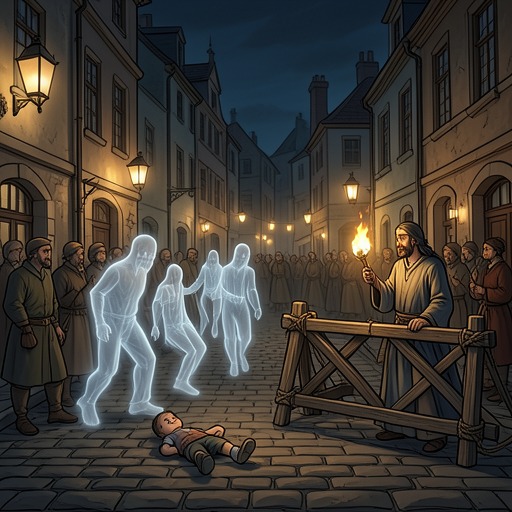
The outbreak had continued for a month before Theo arrived. The people of Ashenhave needed two weeks merely to realize that something was wrong after Ala collapsed. Many residents were farmers, so the town tried bringing them into town to stay overnight, but concentrating the population also drew more ghosts toward the settlement. The response intended to protect the farmers consequently intensified the pressure on the town, turning the inn into an overcrowded refuge.
By the time Theo entered the inn, its main room had been emptied of furniture and filled with at least a dozen bedrolls arranged in rows. The arrangement resembles a makeshift ward, but the setting remains a public lodging house rather than a medical facility. Geg, the goblin innkeeper, keeps adding lanterns and logs to the fire, yet the warm light does not reach the victims’ faces. The contrast between visible care and persistent physical deterioration shows how little ordinary measures can accomplish once ghost-touch has taken hold.
Heat nevertheless provides limited protection. Theo orders the fireplace lit because keeping the victims warm staves off the touch. The instruction does not cure the affliction, but it slows its immediate threat and gives the healer time to work. The town’s improvised treatment therefore combines environmental care with magic: fire and blankets preserve the body, while Theo’s healing addresses the supernatural damage directly.
Theo’s Treatment
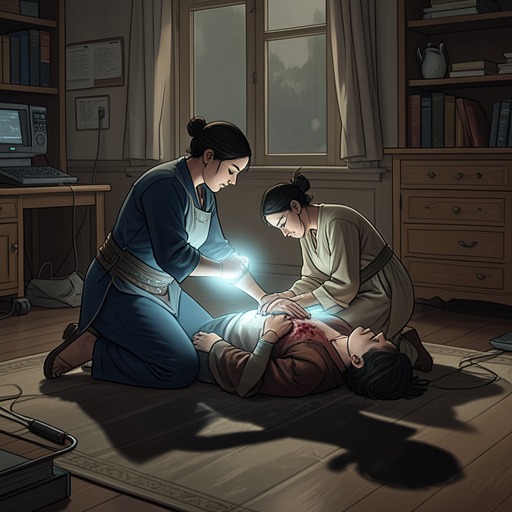
Theo responds to ghost-touch as a healer rather than as a warrior confronting an abstract monster. He asks who has been touched the longest, examines Ala by hovering a hand over her chest, and scans her with magic before directing the townspeople to prepare the room. His green healing light rests over both her forehead and chest, making diagnosis and treatment a visibly embodied process. The crisis is not solved by a single spell or dramatic strike; it requires triage, sustained attention, warmth, and repeated care.
He ends up healing throughout the night. After Ala’s color returns to her face, Theo pauses only long enough to eat sandwiches and drink tea offered by Geg, then continues working. At dawn he finishes healing the last two victims, though the effort leaves him swaying and needing to catch himself against a wall. His exhaustion establishes the cost of treating ghost-touch: the condition may be curable through his abilities, but its victims’ survival depends on prolonged labor that pushes the healer toward collapse.
Theo warns that the recovered victims will experience fever-like symptoms for several days and should regain consciousness soon. He recommends herbal tea and cool cloths, while reserving a later check for Ala and planning to examine the others as they wake. This aftermath matters because healing does not erase the episode at once. Ghost-touch leaves a period of convalescence, and recovery remains a process requiring observation and ordinary nursing after the magical intervention.
Investigation and the Source of the Touch
The outbreak also becomes a mystery requiring specialized knowledge. When Luc and the rest of the party arrive, Theo reports that he is fine but exhausted from healing ghost-touch all night. Garris, the town’s chief, asks whether the ghosts can be stopped, and Wicker explains that he has studied several of them and needs to confirm details about the recent events. The response divides the problem into complementary tasks: Theo repairs the damage already done to living bodies, while Wicker investigates the source and behavior of the apparitions.
The party eventually reaches what appears to be the edge of a small glen and finds a moss-covered well. Its wooden winch and cover have rotted away, although the stone structure remains intact. From within it comes a distant calling and screaming, as if voices are traveling from far below or far away. The ruined well gives the supernatural crisis a physical center, but it also preserves uncertainty: the stone remains solid while the human construction around it has collapsed, leaving the site as a damaged channel between the living settlement and whatever lies beneath.
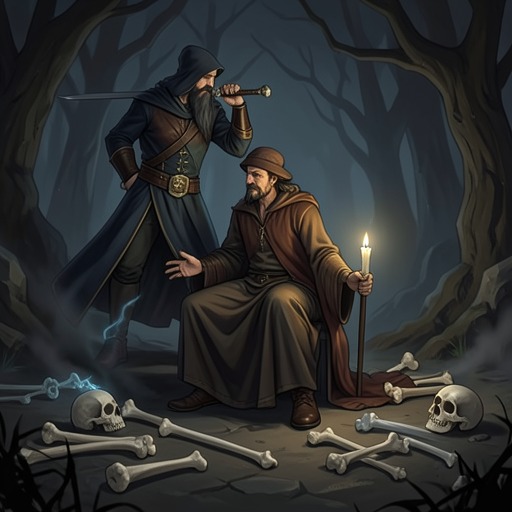
The threat encountered there is a nested corpse, a ghostly creature whose body must be destroyed before the spirit can be reached. Wicker throws a lantern at its feet, coats it in oil, and ignites a torch marked with fire-spell runes. The fire burns through rotten flesh, fur, and finally blackening bones. Once the beast collapses and the flames fade, a silvery figure appears above the remains. The apparition resolves into a clearer image of a boy, whose plea to be taken home reveals that the horror contains a trapped human presence rather than only an animalistic monster.
Meaning and Consequences
Ghost-touch creates a tension between haunting as contagion and haunting as unresolved suffering. In Ashenhave, the ghosts attack residents, force farmers into the inn, and turn a shared refuge into a crowded ward. Yet the nested corpse is not reduced to an enemy once its body burns away: the boy’s remaining figure and repeated request to go home show that purification must also involve recognizing the dead person caught inside the violence. The condition is therefore both a threat to be stopped and evidence of a death that has not found an acceptable end.
That distinction contrasts with the funeral of Glefald in Leafel. Most burials there are bonfires that release the departed soul through smoke and sparks, but Glefald chooses burial in the earth with a tree planted over his body. The community honors that custom, and the tree is placed across from the Watchtower so it will eventually become a second guardian of Leafel. The ritual gives death a location, a memorial, and a continuing relation to the living. Against that image of deliberate burial and renewed life, the abandoned well and the nested corpse represent death without proper settlement: a neglected site from which voices continue to emerge.
Ghost-touch consequently has a social as well as physical significance. It exposes how delayed supernatural harm can pass unnoticed, how protective measures can accidentally gather danger, and how a community must rely on both skilled healing and collective investigation. Theo’s overnight work restores the victims’ bodies, while Wicker’s fire and the party’s search address the source of the attacks. The affliction stands at the boundary between medicine and exorcism, between bodily suffering and the ethical question of what the dead are asking for when they return.